 OPENWORKS IT
Sorted · practice software · in beta

The diary, the notes, the bills. Sorted.
Practice software for South African clinical practices, mental healthcare first: the diary and online booking, clinical notes with the Heidi scribe, billing and medical aid claims, and the books for your accountant. It runs on a South African server, with a standby copy at the practice for when the internet drops. Sorted is a working title.
Today, next, and after that
Sorted is in beta, built a version at a time. Here’s what it does, what’s being finished, and what’s on the list.
Today
Version 0.4, released 27 November 2026
- The diary, with a live Today screen for each clinician.
- Online booking, with no account needed and fake bookings kept out.
- Patients and accounts: families, dependants, guardians and companies.
- Clinical notes, versioned, locked when signed, with private process notes.
- The Heidi scribe inside the consult.
- Steady beside the note, for practices that use it.
- Billing: card, EFT, card payment links and cash-up.
- Medical aid claims, checked before they go, and remittances matched.
- The books for your accountant, laid out for their package.
In development
Version 0.5, in its six reviews now
- Mental healthcare first. Psychiatry, psychology, registered counselling, psychometry, psychiatric nursing, social work and occupational therapy, beside GPs, each with notes made for it.
- Progress and outcomes. PHQ-9, GAD-7 and PCL-5 scores over time against the clinical range, with medicines, therapies and Steady’s check-ins, worked out by published methods. It describes; it never recommends.
- Practice reports. Attendance, no-shows, waiting times, how long care lasts, where referrals come from and how fast schemes pay. Counts only, no patient named.
- Sharing a record between practices, only with the patient’s consent: they choose what is shared and for how long, and can withdraw.
- VAT and credit notes, an accounts check, and Sorted’s side of a link that hands the books to Shap.
- The law page: each law and professional rule Sorted follows, how it keeps to it, and where to read it.
Planned
Not built yet
- Claims through a switch (Healthbridge or SwitchOn), straight to the schemes. For now they go through the switch’s portal or a billing bureau, checked by Sorted first.
- Card machine integration, for speedpoints that allow it.
- SMS and WhatsApp reminders.
- Android and iOS apps from the same build. It installs to a phone or tablet’s home screen today.
- Signed releases, as Steady and Shap have: live servers update only from releases OpenWorks signs.
What it does now
Tested role by role: reception, each kind of clinician, the practice manager, the accountant, and a patient booking on a phone.
- Today
A diary that's always current
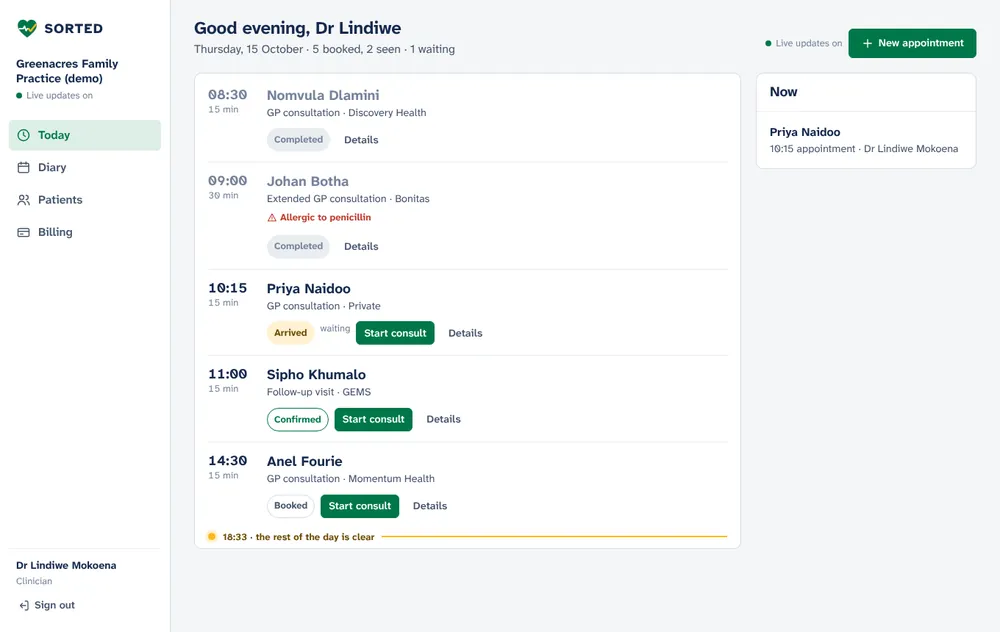
Clinicians side by side, or one across a week. Double-booking is refused unless reception chooses it, and the database enforces that. A clinician’s Today screen updates the moment anyone books, with new online bookings flagged and a gold line for now.
- Today
Booking on a phone
Patients book without an account: service, clinician (or first available), time, details. ID numbers are checked, the time is held until they confirm by email, and they get a calendar invite and a private link to cancel. Fake bookings are kept out without SMS, Google or Cloudflare.
- Today
Patients, families and accounts
Families share one medical aid account with dependant codes, guardians can hold a child’s account, and companies can pay. Duplicates are caught (misspelt names, swapped dates), and every merge can be undone.
- Today
Notes that keep
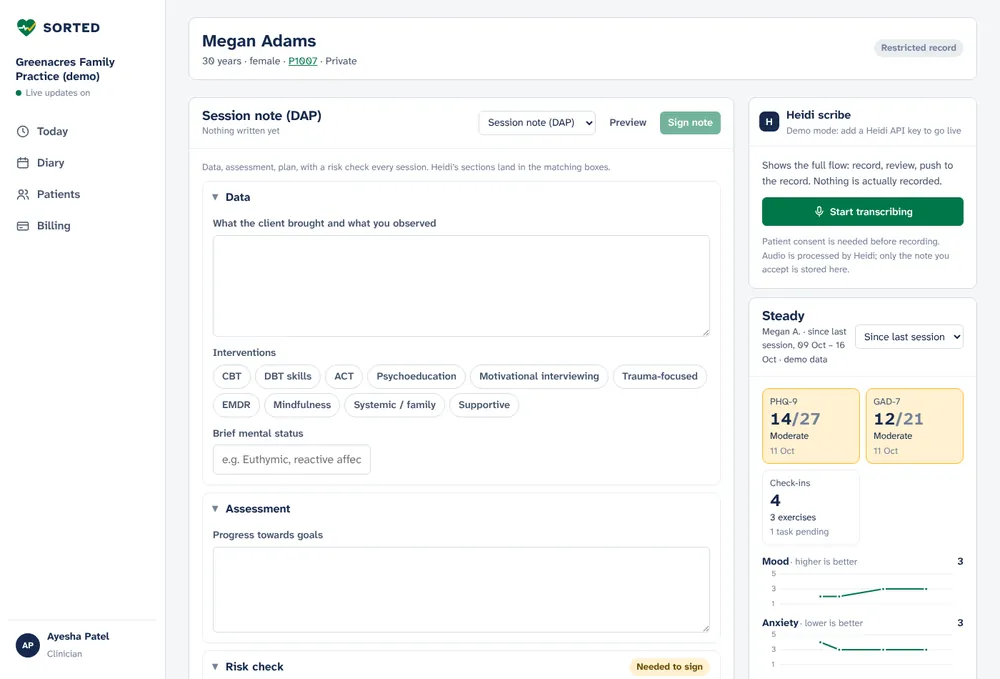
Templates for each discipline, every save versioned, locked when signed (addenda after that). A psychology note can’t be signed without its risk assessment. Restricted records, private process notes, and reception never sees a clinical note.
- Today
Heidi in the consult
The Heidi scribe opens inside the consult. Its note lands in the record as a new version, with its suggested ICD-10 codes carried to the invoice. Transcripts aren’t kept, only the note the clinician accepts.
- Today
Billing and claims
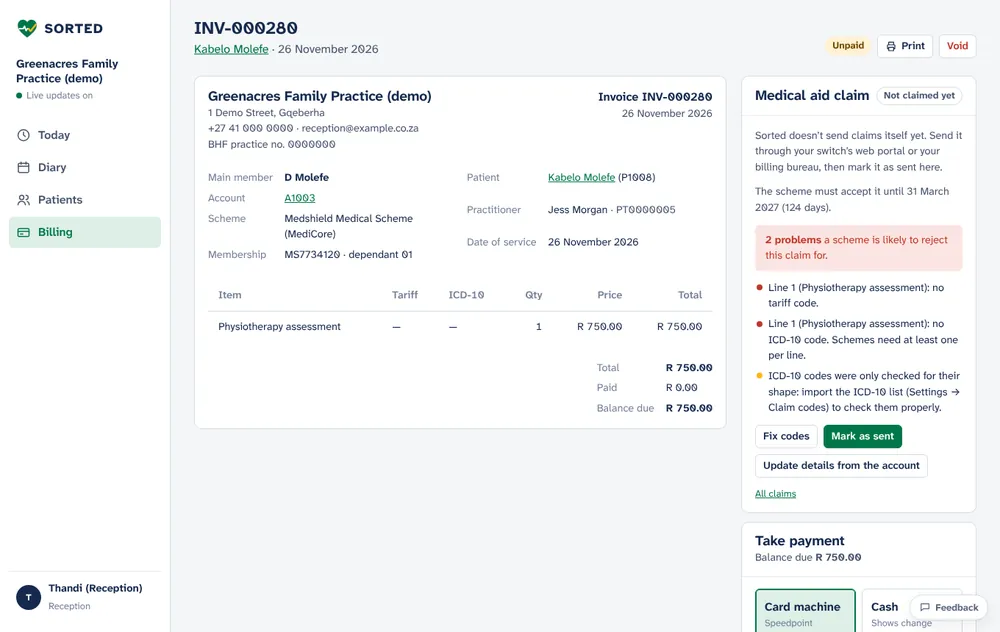
One-tap invoices from the appointment. Card, EFT or a card payment link with a QR code, and a cash-up against the card machine’s batch. Each medical aid claim is checked for what schemes commonly reject, before it goes; remittances are matched and posted.
The demo practice
Screens from Sorted’s made-up demo practice. Every name and number on them is invented.
A clinical record is not a to-do list
Sorted holds a practice’s clinical records and its patients’ accounts, so it’s built and checked like it.
Kept, not deleted
Nothing deletes a patient, a visit or a note. Signed notes and issued invoices can’t change: the database itself refuses.
POPIA, built in
Two-factor sign-in for all staff, an audit log of who opened what, and nothing personal leaves the server without the practice’s or the patient’s yes.
Six reviews a version
Security and privacy with a penetration test, medical law, codes and claims, outcomes and science, invoices and VAT, and the words on screen, each by a reviewer who didn’t write the change.
Up when the internet isn't
A South African server, so clinicians can check their day from anywhere, and a standby box at the practice with a live, read-only copy.
One practice, three tools, no overlap
Steady is the patients’ app between sessions: their check-ins and scores show beside the note in Sorted. Shap does the accounting. Sorted keeps the patients’ accounts (invoices, payments and claims) and hands the books to Shap or to your accountant’s own package. It isn’t an accounting package, and never will be. Sorted is free software under the GNU AGPL v3, like Steady and LineGuard; its code goes public on GitHub once it’s ready.Want to see it?
Sorted is in beta. If you run a practice and want to try it, or shape what comes next, tell us. We'll show you the demo practice and tell you honestly where it stands.
Real people in Gqeberha, who wrote the code you'll be using.